A British garden asks different things of its lighting in April and in December. In June you might be eating outside at nine in the evening with the last of the light still in the sky; by mid-December you are fumbling for a key in the dark at half past four. Good outdoor lighting answers both. The trick is to think in seasons rather than in products, because what goes up in spring may need moving, covering or switching off by the time the clocks change again.
Spring: Waking the Garden Up
Spring is when the garden comes back into use and when last year's lighting gets its first honest inspection. Frost, wet and wind will have found every weak joint. Before you add anything new, walk the route of your existing cables and check clips, seals and connections.
Solar path lights are the easiest way to extend a route through beds or along a lawn edge, but they are only as good as the sun they get. A panel that sat in full light in November may be shaded by a growing shrub or a new fence by May. Move them early, wipe the panels with a damp cloth, and accept that a cheap solar stake gives a soft glow for a few hours rather than serious illumination.
Where solar earns its place
- Marking the edge of a path or drive where a gentle glow is enough
- Filling gaps in a border that is already lit from elsewhere
- Rented gardens, or anywhere you would rather not run cable
Summer: Festoon Strings and Long Evenings
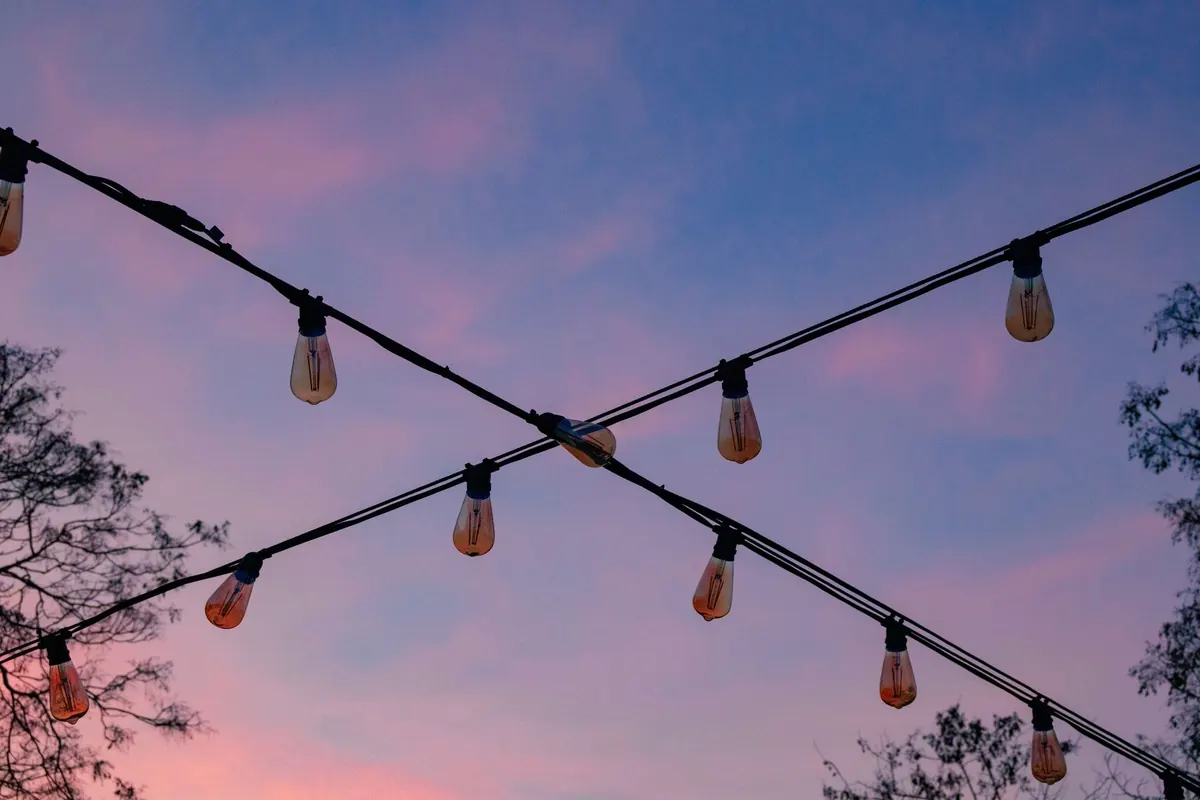
Festoon lights are the backbone of a British summer garden. A string between two fence posts, a pergola and a tree, or across a courtyard instantly turns a patio into a room. Buy connectable sets so you can extend rather than daisy-chain mismatched plugs, and hang them with a little slack — cable under tension is cable that fails.
Most festoons sold for outdoor use are low voltage, running through a transformer from a 13-amp plug. That is safer than mains voltage, but the transformer still needs to live somewhere dry, indoors or in a proper IP-rated enclosure, never lying on wet grass. If you are using mains-voltage sets, plug them into an outdoor socket protected by an RCD, and have a qualified electrician fit one if you do not already have it. This is a job where a professional is worth the money.
Colour and courtesy
Keep colour temperature consistent. Warm white, around 2700K, suits brick, timber and planting; cooler, whiter light makes foliage look flat and slightly clinical. If people will be eating at the table below, a slightly cooler 3000K lamp helps you see what you are doing without losing the atmosphere.
Then there are the neighbours and the wildlife. A garden lit like a car park at two in the morning is a complaint waiting to happen, and constant bright light disrupts moths, bats and hedgehogs. Put festoons on a timer or smart plug and let them go out when you go in.
Autumn: Warmer Light, Earlier Nights
By late September the garden is being used at the edges of the day again. This is the moment to light where you actually walk rather than where you sit: steps, a change of level, the side path to the bins. Low-level fittings set into a wall or a step tread and angled downwards are far more useful than a single bright lantern over the back door.
Autumn is also when uplighting a tree proves its worth. One well-aimed fitting at the base of a mature birch or acer, with a warm narrow beam, gives a whole border presence through winter. Point it up into the canopy rather than across the lawn, and shield it so you cannot see the lamp itself.
Check the practical things too. Falling leaves bury cable and block drains, and wet ground is unforgiving to a joint that was only just sealed. If a connection sits in a hollow or at the bottom of a run, water will collect there. Move it higher or into an enclosure.
Winter: Security, Safety and a Bit of Warmth
Winter lighting has two jobs that pull in different directions: making the house feel secure and making the entrance feel welcoming. A PIR floodlight that snaps on at every passing fox does neither well.
For security, aim the sensor across the approach to a door rather than at the road, keep the beam pointing down, and set the timer to a sensible interval. Modern LED floodlights are far brighter per watt than the old halogen units, so a modest one positioned well usually beats a huge one washing the whole garden in white light. Add a warm white lamp over the door on a timer and the practical lighting stops feeling like a spotlight.
Cold shortens the life of solar lights, because batteries hold less charge at low temperatures and winter sun is weak. Expect reduced runtimes from November to February, and do not assume a fitting has failed when it is simply depleted. If a particular spot matters in winter, plan for a mains or low-voltage option and keep solar for the softer jobs.
Light spilling into a neighbour's window can become a complaint, and councils can treat serious cases as a statutory nuisance. Aim everything downwards, shield the lamp, and use sensors or timers so the garden is not lit all night for no reason.
Weatherproof Ratings Without the Jargon
Every outdoor fitting should carry an IP rating: two digits describing how well it resists dust and water. Higher is better protected, but not automatically better value. A covered porch does not need the same fitting as a pond edge.
- IP44 — splash resistant. Fine under a porch or overhang, and a common rating for festoon sets.
- IP65 — dust tight and protected against water jets. A sensible default for anything fully exposed to British weather.
- IP66 and IP67 — stronger jets and short immersion respectively. Useful near a pond or a low-lying path.
- IP68 — submersible, for pond lights and fittings designed to sit in water.
The rating applies to the fitting, not to your installation. A perfectly sealed lamp connected to a plug lying in a puddle is not weatherproof. Use outdoor sockets with a hinged cover and RCD protection, keep connections above ground level or inside an IP-rated box, and remember that transformers and drivers need shelter too.
A Simple Year-Round Routine
Half an hour twice a year keeps an outdoor scheme working and saves you diagnosing faults in the dark.
- Spring: clean solar panels, test every fitting, and move anything now shaded by new growth.
- Early summer: re-hang festoons with slack, check cable clips, and reset timers for the long evenings.
- Autumn: clear leaves from cable runs, check seals for cracking, and replace batteries before the cold.
- Winter: test PIR sensors and door lights, and keep a torch by the back door for the evening something has gone out.
Buy once, buy decently. A well-made IP65 fitting with a replaceable bulb will outlast three sealed novelty ones and is far less irritating to maintain. Come the next long evening, the garden will already work after dark.
Photo: Bogdan Semenchuk / Pexels